Hi everyone,
Wednesday, February 16, 2022
Meet Elizabeth! Save the Harbor's Senior Staff Assistant
Monday, February 14, 2022
Commission Hearing Focuses on Language Barriers on the Beach
DCR will deploy multi-lingual signs “across our system, including of course, on all the Metropolitan beaches” beginning in 2022.
On Wednesday, February 9, at 10:00
AM, the Metropolitan Beaches Commission
and Save the Harbor/Save the Bay
convened a Virtual Public Hearing to address language barriers on the
Metropolitan Region’s public beaches in Lynn, Nahant, Revere, Winthrop, East Boston,
South Boston, Dorchester, Quincy and Hull.
At the hearing the Commission took testimony from people who do not
predominantly communicate in English about the obstacles they face when they
try to use and enjoy the region’s public beaches.
“Overcoming language barriers is a key issue,” said Chris Mancini, Executive Director of Save the Harbor/ Save the Bay. “If we don’t have diversity in programs and signage on our beaches, folks will be forced to be spectators when they should be involved, active participants.”
Representative Adrian Madaro of East Boston, who Co-Chairs the Commission, set the tone in his opening remarks saying, “in East Boston, language justice and language access are not merely aspirations; they are absolute necessities to ensure the safety, wellbeing, and success of all of our neighbors.”
Participants heard presentations on current and best practices for multilingual signage and websites. “Of the 250 signs we looked at across our Massachusetts coast, just four of them were in languages other than English,” said Bruce Berman, Director of Strategy and Communications of Save the Harbor/Save the Bay. “That’s simply not good enough.”
“QR codes on beach signage is one easy way to connect people to the
multilingual resources they need,” said Save the Harbor/Save the Bay Policy Intern
Caroline Adamson during her presentation, pointing
out that QR codes are already in use on signs in Revere and elsewhere.
Among those who testified at the hearing were Stephanie Cooper, Acting Commissioner of the Department of Conservation and Recreation and Julia Mejia, City Councilor-at-Large, City of Boston.
According to Acting DCR Commissioner Cooper, “we are focused on having our areas accessible and safe. We also need to have signage and information that provides people with the rules and regulations. What are the amenities? What do I need to know to enjoy the beach and be safe?” Cooper underscored the importance of the use of QR codes, observing that, “Save the Harbor/Save the Bay’s presentation highlighted some of where we are headed and some of the progress we still need to make. The great thing about a QR code is that you can provide a lot of information in all the languages that you want. Our plan is to use QR codes this year.”
“I hope that in the years to come our public spaces resemble, more accurately, our community,” said Julia Mejia, Boston City Councilor-at-Large. “When I look at a lot of the signs, oftentimes at our public beaches, everything is still very much in English. I think that we need to do a better job of making sure that, if we are serious about creating spaces where people are seen and reflected, then translation and information justice is a part of that conversation.”
Commission Co-Chair Senator Brendan Crighton of Lynn agreed, and was
“inspired by the powerful testimony” he heard at the hearing. “We look forward
to using this community input to make our beaches more equitable and inclusive
for all people regardless of the language they speak.”
The Metropolitan Beaches Commission welcomes public participation and will gladly accept written testimony from all interested parties. Please email your comments to rodriguez@savethe harbor.org.
For more information about the hearing contact Save the Harbor's Executive Director Chris Mancini by email to mancini@savetheharbor.org or on his cell at (617) 909-6667, or their Director of Strategy & Communications Bruce Berman by email to bruce@bostonharbor.com or on his cell at 617-293-6243.
Recordings of this hearing are available in English,
Spanish, Portuguese, Haitian-Creole, Arabic, Vietnamese, and Mandarin here
About the Metropolitan Beaches Commission
The Metropolitan Beaches Commission is a permanent Commission charged with making findings and recommendations to the Legislature and the Department of Conservation & Recreation (DCR) on ways to improve the metropolitan region's public beaches. It was established by the Massachusetts Legislature in 2006 and is led and managed by Save the Harbor/Save the Bay. You can find more information about the MBC on Save the Harbor/Save the Bay's website, and download copies of our previous reports at https://www.savetheharbor.org/mbc-archives.
Late last spring, the Commission decided to focus attention on ways to increase diversity, equity and inclusion on the Metropolitan Region’s public beaches, to improve access for people of color, people with disabilities, and people who may not speak English as their primary language. Last May, we heard from a diverse group of civic leaders and community members about ways in which we could increase diversity on the beaches and in our beach programming. In November, the Commission focused on ways to increase and improve access for people with disabilities on the Metropolitan Region’s public beaches. The most recent hearing focused on ways to overcome language barriers that prevent people from safely enjoying their beaches.
“We hope these three hearings will enable us to do for equity, diversity and inclusion what we did for management and maintenance of the Metropolitan Beaches during the last rounds of public hearings.” said Commission Co-Chair Senator Brendan Crighton of Lynn. “Working together we will provide DCR, the Commonwealth and our communities a blueprint for improving public access to take these beaches from good to great.”
“Our state beaches are public treasures that belong to all of us,” said Commission Co-Chair Representative Adrian Madaro of East Boston. “We need to advance environmental justice and center diversity, equity, and inclusion so that people of all backgrounds can enjoy them for years to come, no matter what language they may speak.”
Following this hearing on language barriers, the Commission will host a Virtual Summit, at which they will present their preliminary findings to a broad and diverse audience of beach users to get their thoughts and input. Following the Summit, the Commission will share a report of their findings and recommendations with the Legislature, the Administration, DCR and the public. It will serve as a roadmap for improving access and increasing diversity, equity and inclusion on our public beaches going forward.
“The legislative and community members of the Commission hope that this hearing will help us improve the beach experience for people who do not speak English as their primary language,” said Chris Mancini, Executive Director of Save the Harbor/Save the Bay. “We are looking forward to working together with DCR, other state agencies, and our beachfront communities to develop strategies to improve access to these spectacular urban natural resources for people of all languages and backgrounds.”
For more information about the MBC or the hearing, please contact Save the Harbor's Executive Director Chris Mancini by email to mancini@savetheharbor.org or on his cell at (617) 909-6667, or their Director of Strategy & Communications Bruce Berman by email to bruce@bostonharbor.com or on his cell at 617-293-6243.
You can access this release in your
language by using
the Google Translate button on the top left of your browser.
Tuesday, February 8, 2022
Language Barriers on the Beach
Metropolitan Beaches Commission Hearing on Language Barriers on February 9, 2022.
On Wednesday, February 9, at 10:00 AM, the Metropolitan Beaches Commission and Save the Harbor/Save the Bay will convene a Virtual Public Hearing to address language barriers on the Metropolitan Region’s public beaches in Lynn, Nahant, Revere, Winthrop, East Boston, South Boston, Dorchester, Quincy and Hull.
“The legislative and community members of the Commission hope that this hearing will help us improve the beach experience for people who do not speak English as their primary language,” said Chris Mancini, Executive Director of Save the Harbor/Save the Bay. “We look forward to hearing from and working together with local elected officials, DCR, DPH, DEP, DMF, MWRA, other state agencies and our beachfront communities to develop strategies to improve access to these spectacular urban natural resources for people of all languages and backgrounds.”
The public is welcome to attend to share their thoughts on what is working and what can be done better. You can register for the hearing by following this link: https://us02web.zoom.us/meeting/register/tZwudu6oqzMuHdVZoGCTFxuWFXy1J_2khGPD
At King’s Beach and on all of the Metropolitan Region’s urban beaches, water quality, beach rules, and fishing regulations need to be accessible to people that do not speak English as their primary language.
For more information about the MBC or the hearing, please contact Save the Harbor's Executive Director Chris Mancini by email to mancini@savetheharbor.org or on his cell at (617) 909-6667, or their Director of Strategy & Communications Bruce Berman by email to bruce@bostonharbor.com or on his cell at 617-293-6243.
You can access this release in your language on this blog using the Google Translate button on the top left of your browser. As a reminder, there will be live translations in Spanish, Portuguese, Haitian-Creole, Arabic, Vietnamese, and Mandarin.
About the Metropolitan Beaches Commission
The Metropolitan Beaches Commission is a permanent Commission charged with making findings and recommendations to the Legislature and the Department of Conservation & Recreation (DCR) on ways to improve the metropolitan region's public beaches. It was established by the Massachusetts Legislature in 2006 and is led and managed by Save the Harbor/Save the Bay. You can find more information about the MBC on Save the Harbor/Save the Bay's website, and download copies of our previous reports at https://www.savetheharbor.org/mbc-archives.
Late last spring, the Commission decided to focus attention on ways to increase diversity, equity and inclusion on the Metropolitan Region’s public beaches, to improve access for people of color, people with disabilities, and people who may not speak English as their primary language. Last May, we heard from a diverse group of civic leaders and community members about ways in which we could increase diversity on the beaches and in our beach programming. In November, we focused on ways to increase and improve access for people with disabilities on the Metropolitan Region’s public beaches. February’s hearing focuses on way to overcome language barriers that prevent people from safely enjoying their beaches.
“We hope these three hearings will enable us to do for equity, diversity and inclusion what we did for management and maintenance of the Metropolitan Beaches during the last rounds of public hearings.” said Commission Co-Chair Senator Brendan Crighton of Lynn. “Working together we will provide DCR, the Commonwealth and our communities a blueprint for improving public access to take these beaches from good to great.”
“Our state beaches are public treasures that belong to all of us,” said Commission Co-Chair Representative Adrian Madaro of East Boston. “We need to advance environmental justice and center diversity, equity, and inclusion so that people of all backgrounds can enjoy them for years to come, no matter what language they may speak.”
Following this hearing on language barriers, the Commission will host a Virtual Summit, at which they will present their preliminary findings to a broad and diverse audience of beach users to get their thoughts and input. Following the Summit, the Commission will share a report of their findings and recommendations with the Legislature, the Administration, DCR and the public. It will serve as a roadmap for improving access and increasing diversity, equity and inclusion on our public beaches going forward.
“The legislative and community members of the Commission hope that this hearing will help us improve the beach experience for people who do not speak English as their primary language,” said Chris Mancini, Executive Director of Save the Harbor/Save the Bay. “We are looking forward to working together with DCR, other state agencies, and our beachfront communities to develop strategies to improve access to these spectacular urban natural resources for people of all languages and backgrounds.”
For more information about the MBC or the hearing, please contact Save the Harbor's Executive Director Chris Mancini by email to mancini@savetheharbor.org or on his cell at (617) 909-6667, or their Director of Strategy & Communications Bruce Berman by email to bruce@bostonharbor.com or on his cell at 617-293-6243.
You can access this release in your language on this blog using the Google Translate button on the top left of your browser. As a reminder, there will be live translations in Spanish, Portuguese, Haitian-Creole, Arabic, Vietnamese, and Mandarin.
Monday, December 6, 2021
Our Better Beaches Program was Better than Ever!
In preparation for the 2021 beach season, Save the Harbor/Save the Bay convened a public meeting of the Metropolitan Beaches Commission about race and equity on the Commonwealth’s public beaches and used our findings to build a more equitable grant process.
Based on the community’s feedback and Save the Harbor’s values, $40,000 of the 2021 Better Beaches funds were set aside to address barriers in access and equity that community members of color, folks with disabilities, and queer people experience on our region’s public beaches.
We directly addressed the community’s request for more diverse music and food, additional mobility mats and beach wheelchairs, and free life jackets on our region’s beaches by allocating additional funds to new and existing partners with plans to meet these needs. We also continued the two Anti-Racism program initiatives founded in 2020, Harbor Healing and Beats On The Beach, and engaged more new partners than ever before, with 31 of the 67 grantees being new partnerships.
In 2022, we aim to make the process even more equitable by introducing elements of participatory budgeting. We will be asking for community input at every step of the process, following the mantra "Your Beaches, Your Voice, Your Choice!". We can't wait to ear from you throughout the process and see you on the beach next summer!
Friday, December 3, 2021
Metro Beaches Commission and Advocates Call for Better Beach Access for People with Disabilities
On Tuesday, November 30, at 10:00 AM, the Metropolitan Beaches Commission and Save the Harbor/Save the Bay convened a Virtual Public Hearing focused on improving access for people with disabilities on the Commonwealth’s public beaches in Lynn, Nahant, Revere, Winthrop, East Boston, South Boston, Dorchester, Quincy and Hull.
“The legislative and the community members of the Commission hope that this hearing will help us better understand the challenges facing people with disabilities on the metropolitan beaches,” said Chris Mancini, Executive Director of Save the Harbor/ Save the Bay as the hearing began. “We are looking forward to working together with DCR - and all of you here today - to develop strategies to improve access to these spectacular urban natural resources for everyone.”
"For those of you who don't know me, I'd like to let you know that I use a power wheelchair due to a disability I acquired as a teenager," said Commissioner McCosh, who leads Boston's overall effort to ensure accessibility and inclusion for persons with disabilities. "But we don't all only strive for meeting bare minimum requirements. We strive for ideal accessibility, which really goes from accessibility to inclusion." According to McCosh, though there are still challenges to overcome, "we do have the political will and great staff and our city agencies and our state partners. The ADA was signed into law over 30 years ago. How can we go to the next step and really make sure that people with disabilities are included in every aspect of life?"
According to Acting DCR Commissioner Cooper, the pandemic "has taught us what we knew in our hearts: The critical importance of getting outdoors for our collective physical, mental and spiritual health." She underscored the Baker-Polito Administration's commitment to equity and inclusion, and pointed out that "DCR's Universal Access provides adaptive programming and equipment at our pools, skating rinks, beaches, of course, lakes and ponds. The idea is that everybody of all abilities can participate and enjoy themselves at our properties."
![]() |
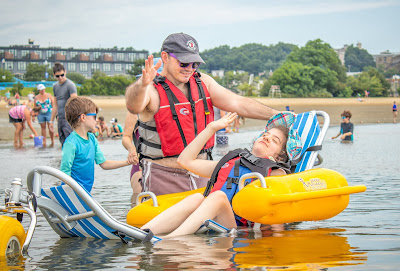
| Investments in ramps, mobility mats and beach and floating wheelchairs are critical to improving beach access for people with disabilities. |
The Commission also heard from experts and advocates serving people with disabilities, including Tom McCarthy, Director of DCR’s Universal Access Program. Coleman Nee, CEO of Triangle Inc., Kathy Lafferty, Executive Director of the South Boston Neighborhood House, Alex DeFronzo, Executive Director of the Piers Park Sailing Center in East Boston, Ellice Patterson, Executive Director of Abilities Dance Boston, and Andrea Gayle-Bennett, Third Junior Vice Commander of the Disabled American Veterans Department of Massachusetts.
Coleman Nee, CEO of Triangle Inc. who has hosted "Beach:Ability" at Constitution Beach in East Boston as part of Save the Harbor/Save the Bay's Better Beaches program partnership with DCR thanked the Commission and Save the Harbor/Savethe Bay for their leadership on this issue. "I cannot stress enough the positive impact on mental health and spirits of those who attended Beach: Ability...our program participants love the beach and they love the ocean," said Nee. "In truth, these beaches are public assets and they shouldn't only be available to the disability community during an event once a year, they should be available all the time. We need additional investments, we need more walkways and ramps, we need proper equipment, we need mobi-mats, we need floating wheelchairs at every beach, and we need all bathrooms and snack stands to be ADA compliant."
Ellice Patterson, Executive Director, Abilities Dance Boston said building cultural understanding is "just as important as the physical access and the equipment to enjoy these beaches. Diverse and disabled beachgoers shouldn't have to fight to explain themselves. We should be able to participate in these spaces like everyone else."
Alex DeFronzo, Executive Director of Piers Park Sailing Center, whose Adaptive Sailing program is a national model, stressed the importance of inclusive programming. "The hard infrastructure for making the beaches accessible is extremely important, but perhaps more important is the human infrastructure of actually programming the beaches and getting groups of people out there. When there are Better Beaches or Universal Access programs running, that's when the beaches feel most welcoming, most successful and most inclusive"
Kathy Lafferty, Executive Director of the South Boston
Neighborhood House agreed, saying "When we offer a program
on the beach, we want everyone to be able to participate. That
means getting on the sand, near or in the water, and not just on
the pavilion to watch. We are in this conversation because we want
to be a part of the solution”
"No one should ever be prevented from sitting on a public beach on a summer day, hearing the crash of the waves or the call of hungry seagulls, especially not because of a disability, much less someone who incurred that disability in service to our country," Gayle-Bennett said. "Public beaches should be for everyone to enjoy."
As the hearing drew to a close, MBC Co-Chair Sen Brendan
Crighton of Lynn thanked Save the Harbor/Save the Bay and
the dozens of community members who took part in the hearing,
saying "The powerful testimony we heard today will help shape
necessary improvements on the Commonwealth's public beaches to
ensure that these resources are always accessible for all."
MBC Co-Chair Adrian Madaro shared that sentiment. “Our
state beaches are public treasures that belong to all of us,” said
Madaro. “We need to advance environmental justice and center
diversity, equity, and inclusion so that people of all
backgrounds, conditions, and abilities can enjoy them for years to
come."
The Metropolitan Beaches Commission welcomes public participation and will gladly accept written testimony from all interested parties. Please email your comments to rodriguez@savethe harbor.org.
For more information about the hearing contact Save the
Harbor's Executive Director Chris Mancini by email to
mancini@savetheharbor.org
or on his cell at (617) 909-6667, or their Director of Strategy
& Communications Bruce Berman by email to
bruce@bostonharbor.com
or on his cell at 617-293-6243.
About the Metropolitan Beaches Commission
The Metropolitan Beaches Commission is a permanent Commission
charged with making findings and recommendations to the
Legislature and the Department of Conservation & Recreation
(DCR) on ways to improve the metropolitan region's public beaches.
It was established by the Massachusetts Legislature in 2006 and is
led and managed by Save the Harbor/Save the Bay. You can find
more information about the MBC on Save the Harbor/Save the Bay's
website, and download copies of our previous reports at
https://www.savetheharbor.org/mbc-archives.
Late last spring the Commission decided to focus attention on ways
to increase diversity, equity and inclusion on the Metropolitan
Region’s public beaches, to improve access for people of color,
people with disabilities, and people who may not speak English as
their primary language. In May, we heard from a diverse group of
civic leaders and community members about ways in which we could
increase diversity on the beaches and in our beach programming.
After the November 30th hearing on improving access for people
with disabilities, in January of 2022 the MBC will hold a hearing
on language barriers that affect public safety and enjoyment on
our region’s public beaches.
Following that hearing, the Commission will host a Virtual Summit,
at which they will present their preliminary findings to a broad
and diverse audience of beach users to get their thoughts and
input. Following the Summit, the Commission will share a report of
their findings and recommendations with the Legislature, the
Administration, DCR and the public. It will serve as a roadmap
for improving access and increasing diversity, equity and
inclusion on our public beaches going forward.
Wednesday, December 1, 2021
Public Policy and Environmental Advocacy
In 2021, with the support of government at all levels and our partners in Boston’s neighborhoods and the region’s beachfront communities from Nahant to Nantasket, Save the Harbor/Save the Bay made important progress on our environmental policy and advocacy agenda, which has two equally important goals.
Improved water quality in the region, with a continued focus on the overall health of the harbor and the bay, improved access to clean water and more accurate beach postings on those metropolitan beaches in densely populated communities that continue to be unsafe for swimming on as many as one out of every five days in a typical year.Pollution from that outfall prevents low-income kids and from that dense and diverse community from enjoying a beach that should be a civic and recreational asset, not a liability.
More equitable and inclusive access to the
harbor, the waterfront, the beaches and the islands. This requires clean
water and stronger physical connections to inland and upland communities of
color and need, improved access for people with disabilities, and increased
participation by people of color and those for whom English is not the primary
language spoken in their homes in both city and state planning processes.
On the state level, Save the Harbor and the legislative leadership and
community members of the Metropolitan Beaches Commission (MBC), which we help
lead and manage for the Legislature, held hearings on equity, inclusion, diversity and better access to the region’s public beaches for people with disabilities are planning a third hearing - and a Summit for early 2022.
Though we understand that systemic change requires sustained effort, we have
already begun to see improvements to public access for people of color and
people with disabilities on the region’s public beaches and increased diversity
at our public hearings, in our free Better Beaches Programs and on the MBC
itself. This will continue to be a priority in 2022. If you would like to take part in the hearings and join us at the summit, email rodriguez@savetheharbor.org
At the city level, we are working closely with our partners in the community
and the City of Boston’s planning and development agency, the Commonwealth’s
DEP, and the private sector, to make
certain that Bostonians of every race and ability are included in the planning
process and the governance of public spaces on the waterfront, and that our
activation strategies for the waterfront and the watersheet are in service of
that goal.
As a result, we have begun to see improved physical connections like the South Bay Harbor Trail and the Nubian Shuttle, as well as programmatic connections and activation strategies that will bring more diverse events, programs and audiences to the waterfront, the Fort Point Channel and the Seaport.
Wednesday, November 24, 2021
Public Hearing on Improving Beach Access for People With Disabilities on November 30
On Tuesday, November 30, at 10:00 AM, the Metropolitan Beaches Commission and Save the Harbor/Save the Bay will convene a Virtual Public Hearing focused on improving access for people with disabilities on the Commonwealth’s public beaches in Lynn, Nahant, Revere, Winthrop, East Boston, South Boston, Dorchester, Quincy and Hull.
The public is welcome to join us to share their thoughts on what is working and what we can do better. You can register for the hearing by following this link https://us02web.zoom.us/meeting/register/tZUtfuqgrj0sG9TqjeIa1rCNflHCx69GR_mF
| Floating wheelchairs and mobility mats made it possible for the Wallis family to enjoy a day at the beach this summer thanks to Save the Harbor/Save the Bay’s Better Beaches Program and Triangle, Inc. |
At the hearing, we expect to hear from members of the disability community as well as a panel of experts including; Kristen McCosh, Commissioner of the Boston Disabilities Commission, Coleman Nee, Chief Executive Officer of Triangle, Inc., and Kathy Lafferty, Executive Director of the South Boston Neighborhood House. Stephanie Cooper,  Acting DCR Commissioner, is also expected to attend.
About the Metropolitan Beaches Commission
The Metropolitan Beaches Commission is a permanent Commission charged with making findings and recommendations to the Legislature and the Department of Conservation & Recreation (DCR) on ways to improve the metropolitan region's public beaches. It was established by the Massachusetts Legislature in 2006 and is led and managed by Save the Harbor/Save the Bay. You can find more information about the MBC on Save the Harbor/Save the Bay's website, and download copies of our previous reports at https://www.savetheharbor.org/mbc-archives.
Late last spring the Commission decided to focus attention on ways to increase diversity, equity and inclusion on the Metropolitan Region’s public beaches, to improve access for people of color, people with disabilities, and people who may not speak English as their primary language. In May, we heard from a diverse group of civic leaders and community members about ways in which we could increase diversity on the beaches and in our beach programming.
“We hope to do for equity, diversity and inclusion what we did for management and maintenance of the Metropolitan Beaches.” said Commission Co-Chair Senator Brendan Crighton of Lynn. “Working together we will provide DCR and our communities a blueprint for improving public access to take these beaches from good to great.”
After the November 30th hearing on improving access for people with disabilities, in January of 2022, the MBC will hold a hearing on language barriers that affect public safety and enjoyment on our region’s public beaches.
“Our state beaches are public treasures that belong to all of us” said Commission Co-Chair Representative Adrian Madaro of East Boston. “We need to advance environmental justice and center diversity, equity, and inclusion so that people of all backgrounds, conditions and abilities can enjoy them for years to come.”
Following that hearing, the Commission will host a Virtual Summit, at which they will present their preliminary findings to a broad and diverse audience of beach users to get their thoughts and input. Following the Summit, the Commission will share a report of their findings and recommendations with the Legislature, the Administration, DCR, and the public. It will serve as a roadmap for improving access and increasing diversity, equity, and inclusion on our public beaches going forward.
“The legislative and the community members of the Commission hope that this hearing will help us better understand the challenges facing people with disabilities on the metropolitan beaches,” said Chris Mancini, Executive Director of Save the Harbor/ Save the Bay. “We are looking forward to working together with DCR to develop strategies to improve access to these spectacular urban natural resources for everyone.”
For more information about the MBC or the hearing, please contact Save the Harbor's Executive Director Chris Mancini by email to mancini@savetheharbor.org or on his cell at (617) 909-6667, or their Director of Strategy & Communications Bruce Berman by email to bruce@bostonharbor.com or on his cell at 617-293-6243.